




Is the chip selloff the bond market repricing duration, or the stock market finally repricing AI capex?
That’s the only question worth sitting with right now, because the two answers demand opposite trades. One is a flush you buy after the structure repairs. The other is a trap with a convincing story attached.
Here’s what’s forcing the question. September CPI printed at 3.7% year over year, a four-month high, and core PPI came in at 5.0%. Odds of another Fed hike in October have repriced from roughly 22% to 37%, and the 10-year yield is sitting near 5.2%, territory it hasn’t seen since 2007. That’s a probability, not a decision. The Fed doesn’t meet until October 27-28.
When the discount rate rises, the market doesn’t sell everything equally. It sells the stuff whose value lives farthest in the future. High-multiple semis and AI infrastructure names are long-duration assets; mega-caps gushing cash are not. That’s the hypothesis. Now the tape.
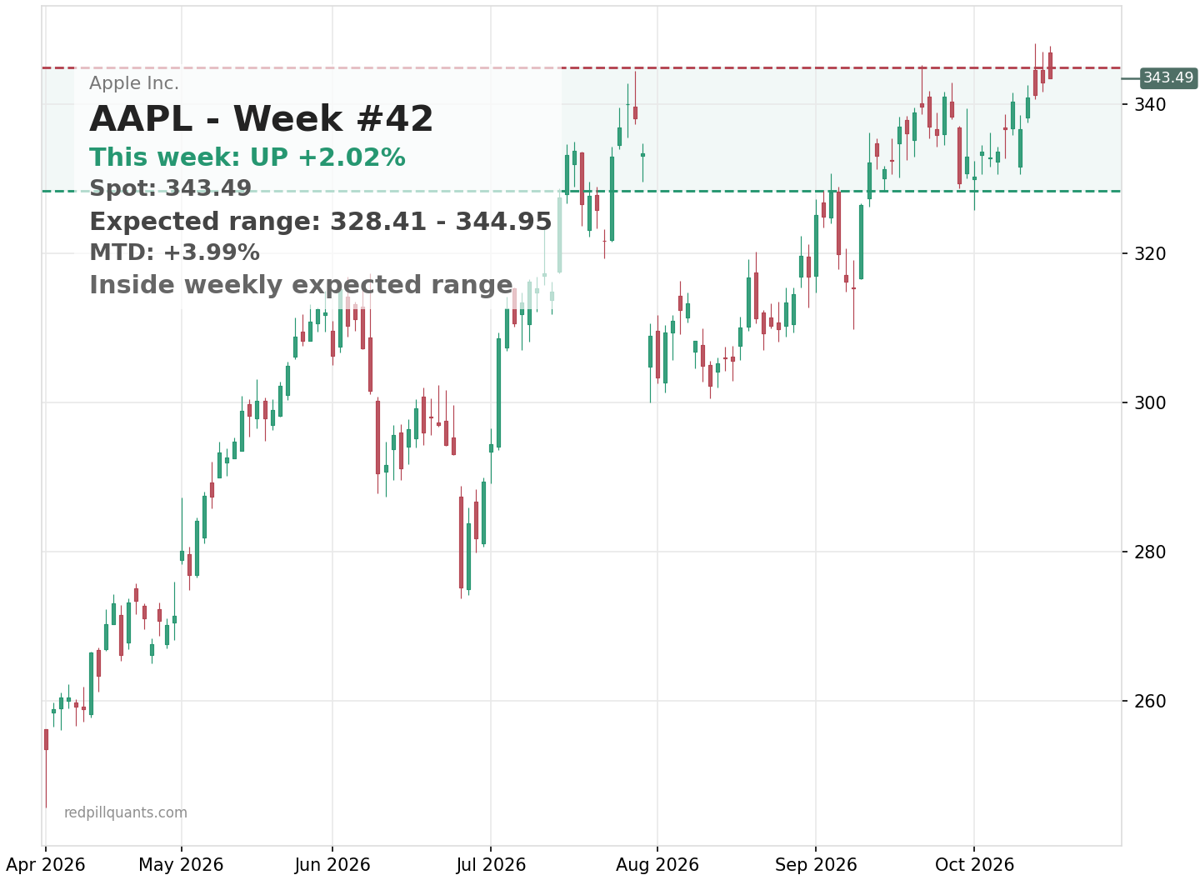
AAPL closed at a record $344 and is sitting at a $5T market cap, only the second U.S. company to get there. It was also the only Mag 7 name to finish green after the CPI print. It’s up about 2% on the week, trading in the top 10% of its three-month range, and still inside a very narrow weekly expected move of roughly $328 to $345 with nothing broken.
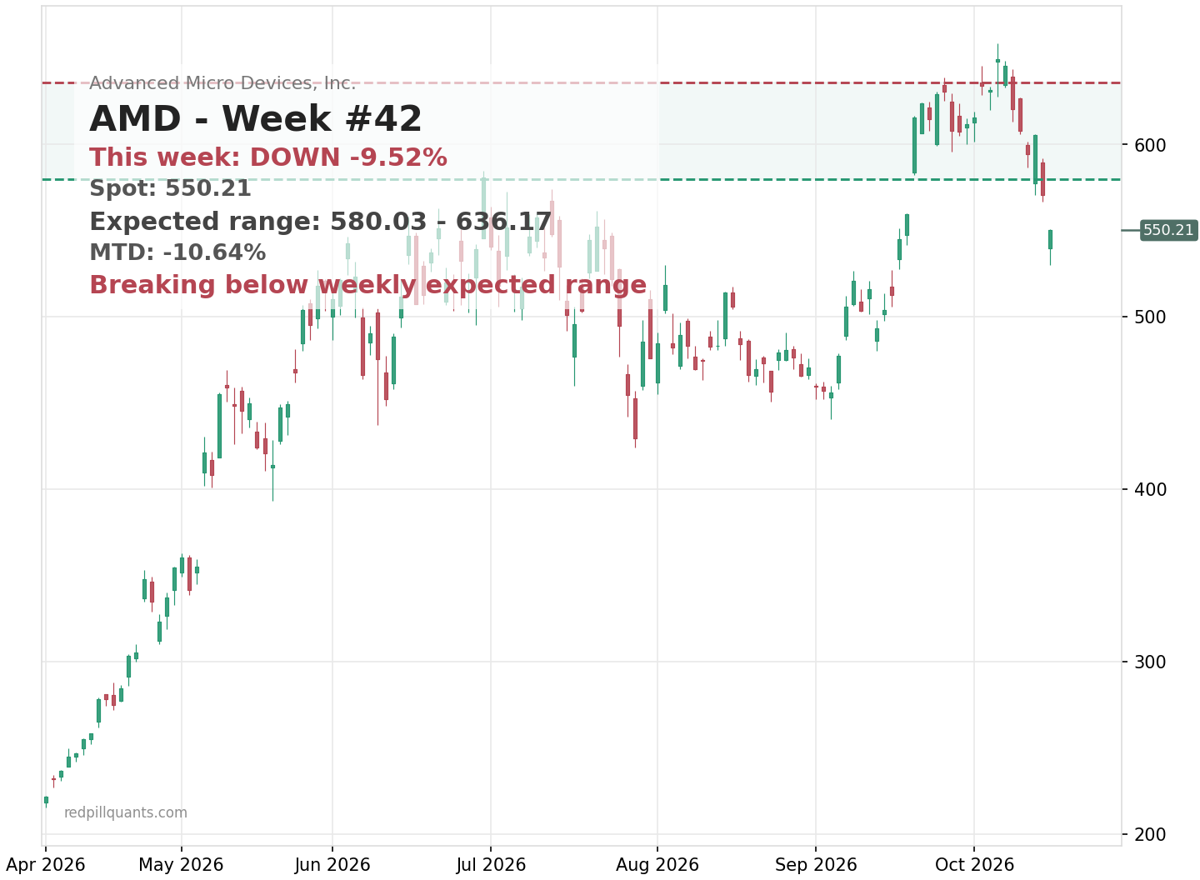
AMD is the other side of the same coin. Down about 10% on the week and roughly 13% over two, closing at $550 after a 3.65% down day. More important than the size: price has pushed below the lower bound of its weekly expected move near $580. That’s a repricing, not chop inside a range, and the trend structure I track has flipped to a fresh bearish transition.
QQQ tells you this isn’t contagion, at least not yet. It’s down about 3.5% on the week and pressing below its own weekly expected-move floor near $739, which is real weakness. But the damage is concentrated in semis and AI infrastructure, not the whole index.
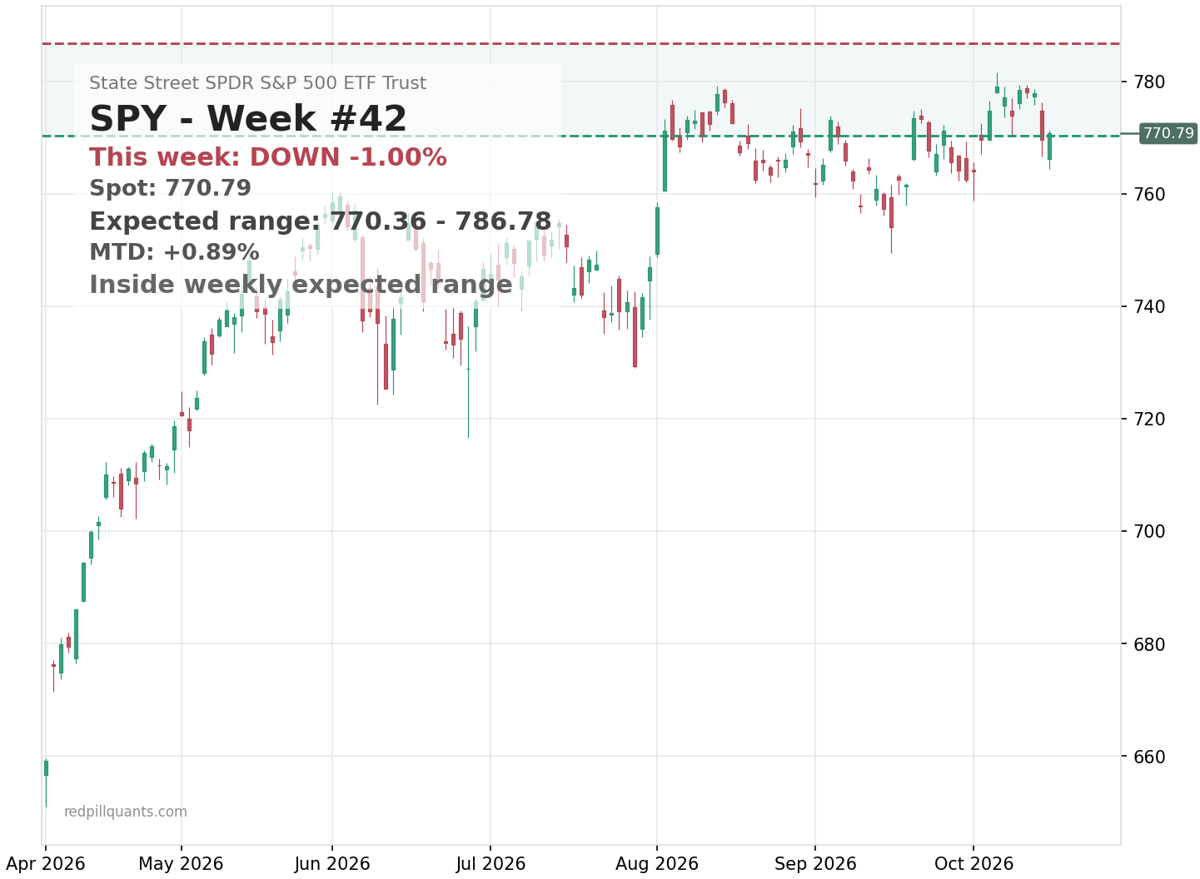
SPY makes the same point from the other direction. Essentially flat on the day, holding inside a very narrow weekly expected move of roughly $770 to $787, with the uptrend near three-month highs intact. VIX sits under 17, and the tape is not pricing a crash.
The reported flow tells the same story: net selling in chips, buying in healthcare and cash-generative defensives. Rotation, not exit. The open question is why the money is leaving chips.
So which is it? The rates case: TSM just printed strong earnings and NVDA hasn’t touched its 2028 guidance, which suggests the selling may be rates doing the talking rather than fundamentals. The capex case: AI capex and debt concerns were already simmering, and hot inflation may have been the excuse rather than the cause.
Price will answer it. If AMD reclaims that $580 area while yields keep rising, the rates read gets stronger – the market sold the multiple, not the business. If chips keep bleeding on days when rates are calm, the market is voting on capex, and the first bounce is a hero trade rather than an entry. Calling bottoms costs nothing until you size it.
I’m not interested in catching the first bounce in a name that just flipped bearish below its expected move. If it’s rates, there will be a better entry after the structure repairs. If it’s capex, there will be no shortage of confirmation, and none of it will be pleasant.
This kind of read – who’s carrying duration risk and who isn’t – is what SPY Alpha is built to trade systematically, for equities and index options. If you want the signals behind it, check it out here.
Cheers,
Michael